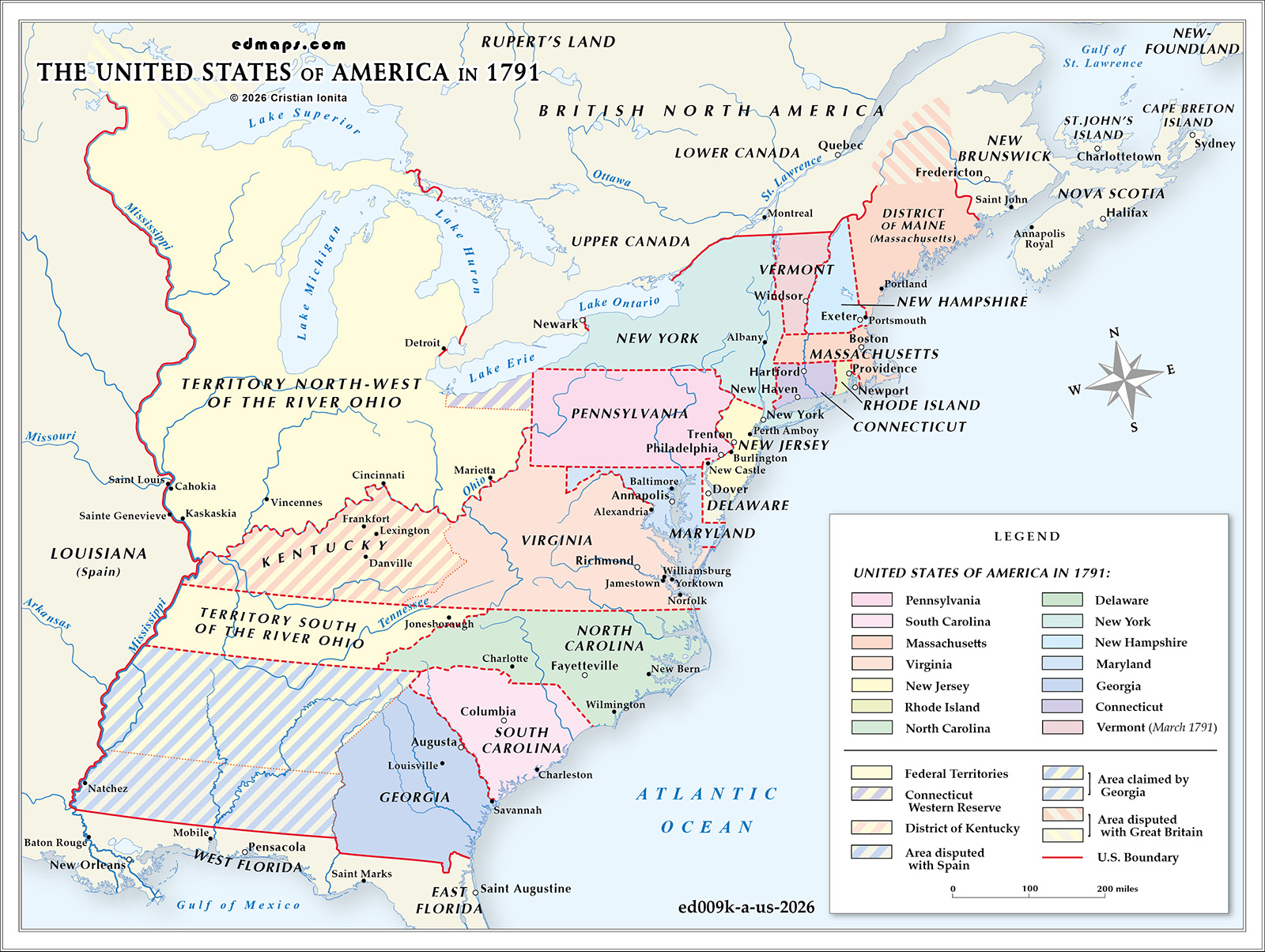
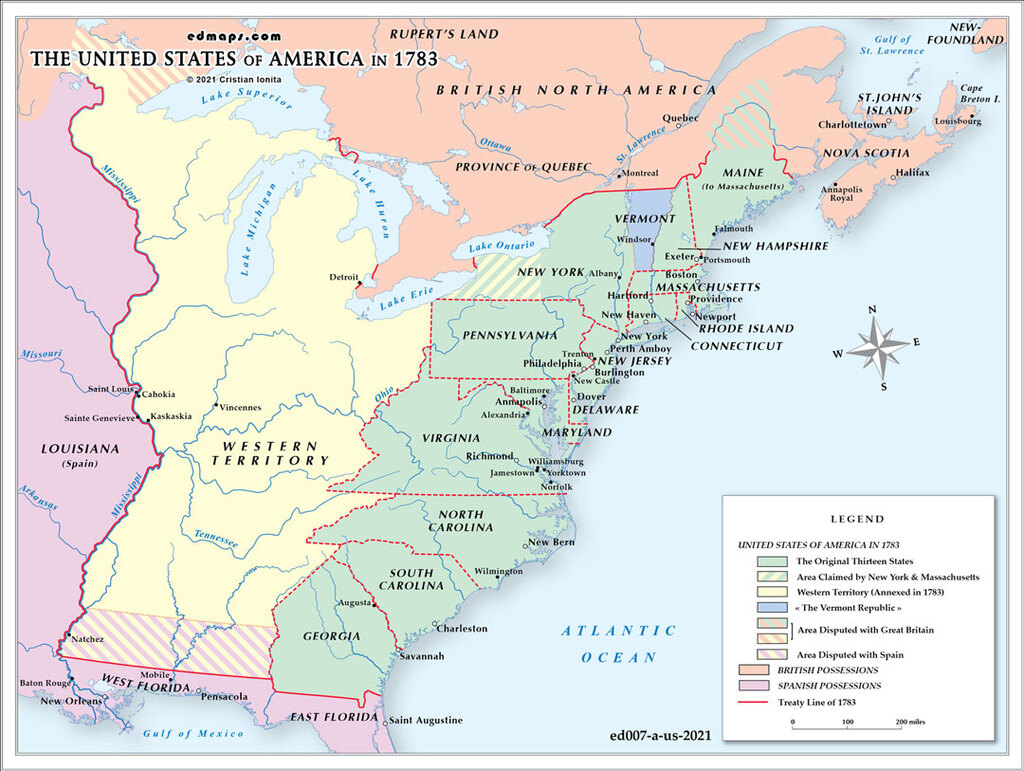
By 1791, the United States was entering a new phase of territorial consolidation and administrative development under the Constitution. The young republic, still defining the contours of its federal system, was beginning to expand beyond the original post‑Revolutionary framework established in 1783.
The most significant change of the year was the admission of Vermont as the fourteenth state. Long functioning as an independent republic since the 1770s and claimed at various times by both New York and New Hampshire, Vermont’s entry into the Union marked the first expansion of the United States beyond the original thirteen states. Its admission also helped stabilize the northeastern frontier, resolving long‑standing jurisdictional disputes in the upper Connecticut River valley.
At the same time, Congress approved the petition for Kentucky’s statehood, setting the stage for its formal admission in 1792. Still legally part of Virginia in 1791, Kentucky had developed a distinct political identity shaped by rapid population growth, frontier settlement, and the challenges of trans‑Appalachian governance. Congressional approval signaled the federal government’s willingness to integrate western regions as full states, reinforcing the territorial principles outlined in the Northwest Ordinance.
The federal territorial domain remained centered on the Territory Northwest of the River Ohio, extending north of the Ohio River toward the Great Lakes. Settlement was still limited, and American authority was contested by powerful Indigenous nations who controlled much of the interior. To the south, the Territory South of the River Ohio, organized only the previous year from North Carolina’s land cession, was beginning to take shape under federal administration, though its social and legal structures differed markedly from those of the Northwest.
Several boundary uncertainties persisted. Georgia continued to claim vast lands stretching toward the Mississippi River, while Spanish control of Florida and Louisiana shaped the geopolitical landscape of the southern and western frontiers. The northern boundary with British Canada remained only partially surveyed, particularly in the Great Lakes region.
In 1791, the United States thus stood at a moment of early expansion and institutional consolidation. The admission of Vermont and the impending statehood of Kentucky signaled the emergence of a continental republic whose borders, political structures, and territorial ambitions were beginning to extend beyond the original Atlantic seaboard.